
or The Burle Who Had a Complaint
One winter evening, the burle blows so fiercely that even the stones hesitate to remain standing.
You can hear them whisper to one another:
— “Are you holding?”
— “I’m holding… but I make no promises.”
Shutters slam. Weather vanes lose their sense of north. Fir trees bend as though searching for something they have forgotten.
Inside the inn, everything is calm.
The fire crackles dutifully, like a model pupil.
Glasses clink softly.
A soup simmers without making a fuss.
One might believe the storm does not exist.
But the mountain knows.
Suddenly, someone knocks.
One sharp knock.
Then two.
Then three, very dignified.
The guests look at one another.
— “At this hour?”
— “In this wind?”
The innkeeper wipes his hands on his apron and opens the door.
No one.
At least, no one you can see.
But the door itself decides to come in.
A gust sweeps through the room. The flames straighten as if being inspected. Napkins tremble. A chair politely steps back.
And a voice, slightly whistling, slightly icy, declares:
— “Good evening.”
The innkeeper narrows his eyes.
— “Good evening… Who are you?”
A swirl forms near the counter. It lifts a little flour, a little ash, and a little pride.
— “I am the burle.”
Silence.
Someone drops a spoon.
The burle continues, offended that no one bows more deeply:
— “Yes. The burle. The one who flattens fences. The one who flips hoods inside out. The one who teaches men to walk bent against the wind.”
A glass slides an inch.
A candle goes out — but very dignifiedly.
— “And to what do we owe the honor?” asks the innkeeper.
The burle blows — which, for her, means she is thinking.
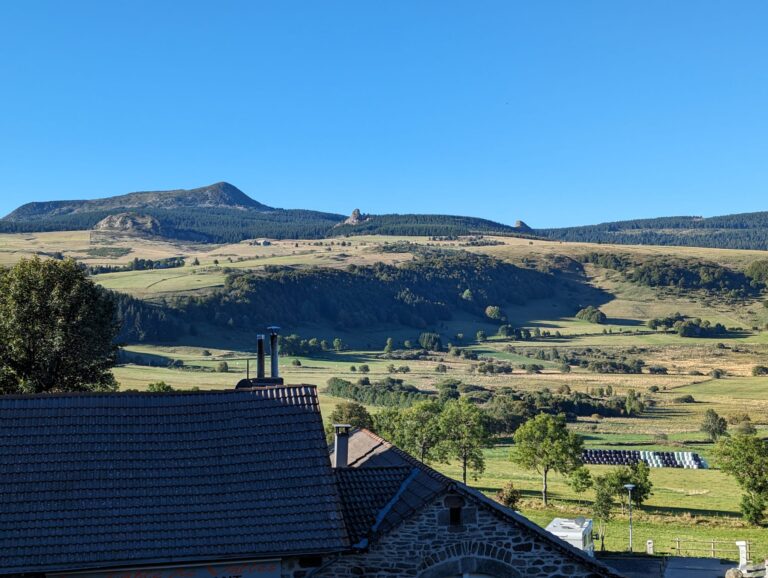
(Up on these high plateaus of the Mézenc, the burle is no ordinary wind. She is the dry, cutting mountain gust that scrapes the land clean and teaches shepherds humility.)
— “I have heard that, here, travelers come in trembling… and leave standing straight.”
She circles the tables, inspects the plates, lifts the tablecloths.
— “I find that suspicious.”
A guest ventures to murmur:
— “Suspicious?”
— “Yes!” hisses the burle. “It is my job, normally. I am the one who shapes men. I am the one who hardens them. I am the one who puts them to the test.”
She billows the curtains to impress the assembly.
— “And yet I have observed that some, after passing through here, resist me better.”
The fire crackles louder. Not in defiance. In politeness.
The innkeeper gently closes the door — as much to prevent the chairs from flying as to contain meteorological sensitivity.
— “Have a seat,” he says.
— “I do not sit.”
— “Then… stay.”
The burle hesitates. She is not accustomed to being invited.
Outside, she commands.
Inside, she is received.
She swirls once more, for appearance’s sake.
Then she declares:
— “Very well. I shall examine.”
And she begins.
She blows over a bowl of soup.
The soup steams more vigorously.
She tries to cool a warm loaf of bread.
The bread crackles with pleasure.
She turns her attention to a glass of wine.
The wine trembles… but does not yield.
The burle stops.
— “Strange…”
A guest breaks the bread.
Another raises his glass.
An old woman laughs.
The burle watches.
She blows again. More gently.
Then, in a voice almost surprised:
— “It is not the heat of the fire…”
She falls silent. Which, for her, is already an answer.
No one replies.
Because everyone knows she is beginning to understand.
And understanding, for a wind, is a delicate exercise.
The burle says nothing for a moment.
It is her way of preparing an inner storm.
She circles the tables once more, like a bailiff searching for a fault in a spotless plate.
Then she plants herself in the middle of the room — if one may say that a wind can plant itself — and declares, with offended politeness:
— “I am told that here, people leave stronger than when they arrive. I put them to the test. You make them soft.”
She pronounces soft the way one would pronounce crime.
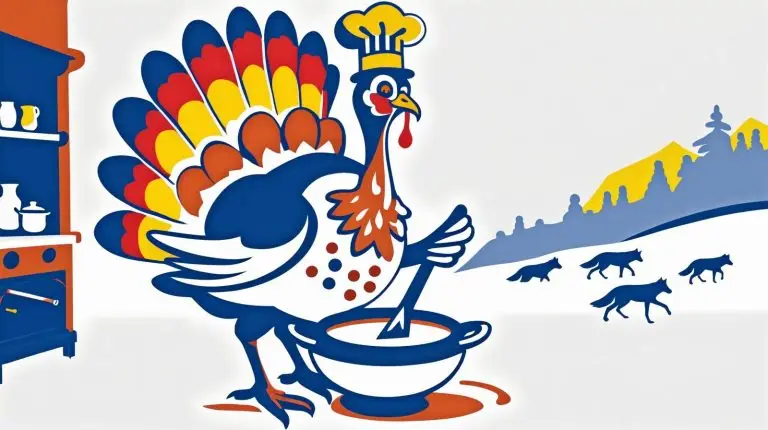
And it is at that precise moment that the Dindon, who does not like people speaking without understanding, descends from his beam.
He does not hurry. He never hurries. He considers haste to be a form of confession.
— “Soft?” he says, smoothing an imaginary feather. “You confuse warming with weakening.”
The burle snickers.
It is not laughter. It is a horizontal draft.
— “I make men bend.”
She approaches a guest and nearly lifts his chair to illustrate her point.
— “I make them stand,” replies the Dindon.
He does not raise his voice.
He does not need to.
The burle whirls around him.
— “Stand? With white tablecloths and warm plates?”
— “With broken bread.”
— “Ridiculous.”
— “With shared wine.”
— “Sentimental.”
— “With a table.”
The burle hesitates for half a second.
She has never fought a table before.
— “I flatten fences!” she resumes, to reassure herself.
“I tear off hats! I drive flocks back early!”
— “Very well,” says the Dindon. “You make them come in.
We make them go back out.”
A silence settles.
Even the fire seems to listen.
The burle then decides to stay for dinner. Or rather… to stay until the end.
— “I shall supervise,” she declares. “To verify this softening.”
She blows lightly over the soup.
The soup steams more vigorously, as if taking it as a compliment.
She tries to extinguish the candles.
The flames bend, tremble — then straighten again with almost polite stubbornness.
She turns her attention to the bread.
The bread crackles under a guest’s hand.
— “Here,” the guest says, handing a piece to his neighbor.
The burle watches.
Another raises his glass.
— “Until tomorrow.”
— “Until tomorrow.”
The burle tightens her current.
She begins again. She blows harder. She lifts a napkin, makes a tablecloth dance, sets a windowpane trembling.
But each time a guest breaks the bread, each time a glass is raised, each time laughter bursts out, she feels something she does not recognize.
A warmth.
Not the warmth of the fire.
The fire, she knows how to extinguish.
Not the warmth of the soup.
The soup, she knows how to cool.
Something else.
Something that does not scatter.
She circles a hiker with wind-reddened cheeks.
— “I was up there this afternoon,” he says.
“I thought I would never make it.”
— “And now?” someone asks.
— “Now… I am no longer afraid to go back.”
The burle stops short.
She recognizes this man.
She had pushed him against the stones. She had forced him to lower his head.
He did not break.
He straightened.
She blows again, but more gently.
— “That is not logical,” she murmurs.
— “It is,” replies the Dindon.
— “I make them bend.”
— “We feed them.”
— “I put them to the test.”
— “We give them the desire to return.”
The burle remains still.
Which, for a wind, is a considerable admission.
She looks at the bread.
She looks at the wine.
She looks at the hands reaching toward one another.
And for the first time in her meteorological career, she does not try to overturn the table.
She tries to understand.
By the end of the meal, the plates are empty.
Which is a very good sign.
The glasses are not quite empty.
Which is an even better one.
The voices have grown softer.
Not from fatigue. From contentment.
The burle no longer whirls.
She moves gently between the tables, as if counting the crumbs.
She lifts one, sets it back down.
She brushes a cheek without stinging it.
Out of professional reflex, she attempts to slam a window.
The window resists — without arrogance.
She approaches the hiker.
He calmly ties his scarf.
He adjusts his gloves.
— “Is it still blowing out there?” someone asks.
— “Yes,” he answers with a smile. “But it will be all right.”
The burle recoils by half a current.
She does not understand.
She had battered him all afternoon.
She had whistled in his ears, frozen his fingers, tried to make him regret every step.
And now he places his hat back on his head with suspicious calm.
The burle crosses the room.
She notices an old woman standing straighter than when she arrived.
A couple no longer arguing.
A silence that does not weigh.
She stops before the Dindon.
He is there.
Still.
Present.
— “So it is not the wind that sets men in motion…” she murmurs.
It is no longer an accusation.
It is almost a scientific discovery.
The Dindon inclines his head slightly.
— “No.”
He does not elaborate.
He believes great truths require few explanations.
The burle casts one last glance at the tables.
Broken bread.
Shared wine.
Hands clasped together.
She inhales — which, for her, means she does not blow.
And something in her shifts direction.
Not her strength.
Not her nature.
Only her gaze.
She opens the door without slamming it.
Outside, she resumes her course.
She still blows.
She still bends hoods and rattles fences.
But she now knows that she merely tests the steps.
The rest happens here.
Inside.
And in the silence that follows her departure, the final sentence falls, simple and evident:
“Good bread and good wine set the soul upon its way.”